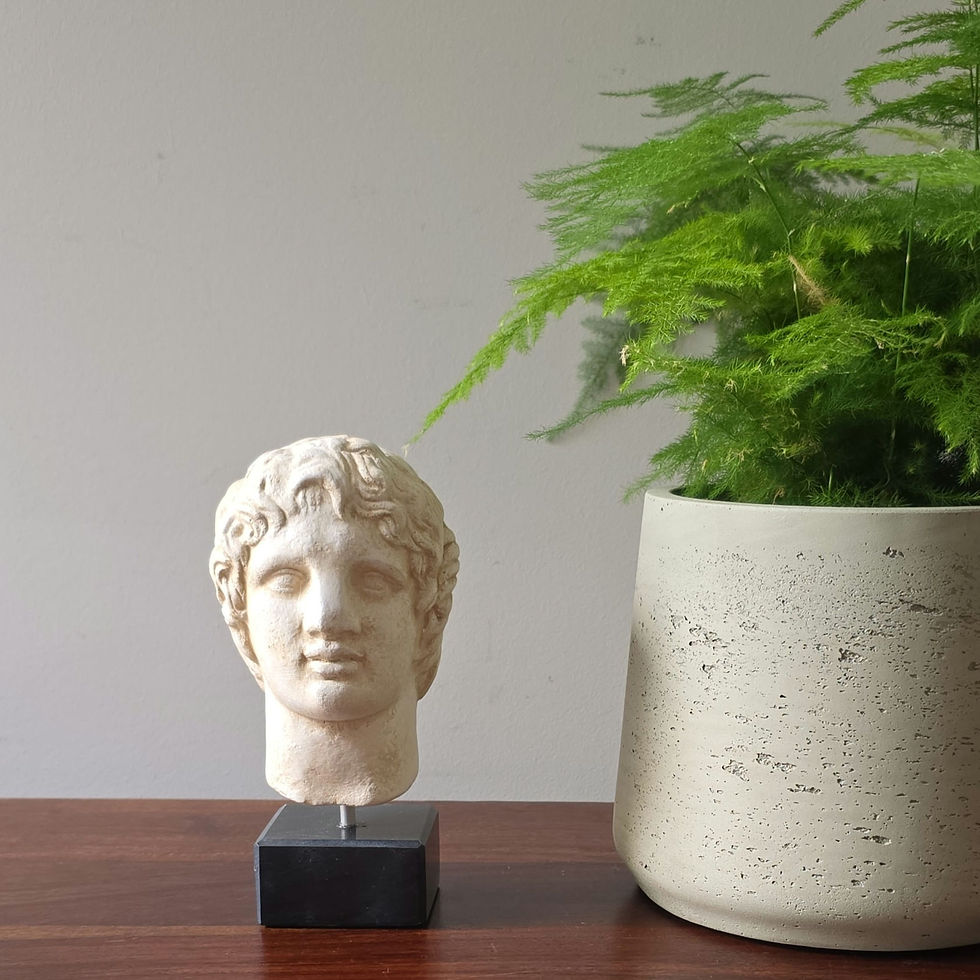
A perfect gift for anyone interested in ancient Greek philosophy!

Bought separately, they are £65 each, so... go for it and save by buying the set!
ancient Greek philosophers trio of Sokrates, Plato and Aristotle
Height including their base:
Plato: 20cm
Aristotle: 19cm
Sokrates: 18.5cmThe material is keramin, a durable plaster polymer compound with a light ochre finish applied by hand. There may, therefore, be a slight variation in colour from piece to piece. The piece is mounted on a marble base.
Made in Greece in the workshop of the Semitekolo family with whom It's All Greek has been working since 1999.
They are identical in dimensions to their bronze equivalents.
Ancient Greek philosopher and polymath! 384-322 BCE. His writings covered a broad range of subjects, spanning the natural sciences, logic, philosophy, linguistics, economics, politics, rhetoric, psychology, and the arts.
At 18, he moved to Athens from his birthplace in northern Greece, and joined Plato's Academy in Athens, where he stayed until he was 37, when he was asked by Philip of Macedon to go and tutor his son, Alexander the Great. At 50, he returned to Athens and founded the Peripatetic school at the Lyceum. Aristotle's works filtered through into Roman philosophy and beyond. Even into aspects of Islamic philosophical tradition, and into Scholastic philosphy under, for example, Thomas Aquinas.
(aside: the Lyceum was a temple in Athens dedicate to Apollo Lykaios. The remains of the Lyceum were discovered in 1996 and you can now go and visit the site. It's calm and peaceful, beautifully landscaped. And it's within easy walking distance of the Cycladic Museum!)
Together with his teacher Sokrates and his pupil Aristotle, Plato formed an essential part of the great trio of ancient Greek philosophers.
Plato was a mathematician, a writer of philosophical dialogues, and the founder of the Academy in Athens.
Thought to be the son of a stone-mason, this famous Athenian philosopher believed in teaching through encouraging and challenging others to question their beliefs, preconceptions and prejudices.
He wrote nothing himself: it is mainly through Plato's early dialogues and Xenophon's memoirs that we know about his teaching methods and personality. He condemned the often glib, ready-made rules for success as offered by the Sophists, and regarded it as his duty to shake people out of ill-founded complacency.
He was condemned to death in Athens in 399BC, aged 70, and forced to drink hemlock.