
free DPD UK shipping over £50 | bespoke worldwide shipping


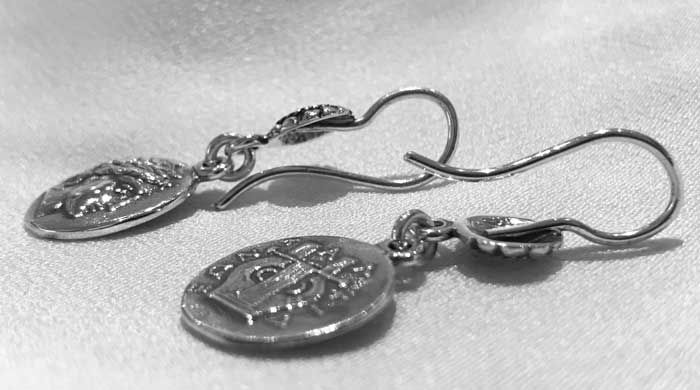


Apollo and lyre coin earrings
£70.00
The original coin, dating from ca 395-392BC is a silver tetradrachm from Olynthos in Chalkidiki in northern Greece. The cities of Chalkidiki in the northern Aegean, among them Olynthos, Mende and Potideia, were founded as colonies by the city of Chalkis on the island of Euboia. The coin reads 'Chalkideon' (of Chalkidiki). Laureate Apollo, with his signature wreath, is depicted on the side. He was the verstile god of the sun, light and progress, culture and the arts, music, poetry, medicine, healing, prophecy and oracles. The lyre is a kithara type, with seven strings. Hermes, who according to mythology invented the lyre with three strings, gave it to Apollo, who added another four. Drop when worn: 4cm Diameter of coin: 1.5cm
quantity
about Apollo
Apollo was an especially multi-faceted and versatile god. His spheres of influence included the sun and light, culture and civilisation, medicine, disease and healing, prophecy and oracles, music, dance, poetry, and archery. He was worshipped as a nurturer of youth - kourotrophos - and as a guardian of children into adulthood. At their coming of age, boys would cut their hair and dedicate it to him.
He was the son of Zeus and the mortal Leto, who gave birth to him and his twin sister Artemis on the Cycladic island of Delos, which Zeus arranged should emerge from the Aegean Sea for this special event. Two of his four children were Asklepios (with the nymph Coronis) and Orpheus (with the Muse Kalliope), Hyacinthus and Cyparissus were his male lovers, and he also fell in love with the Trojan princess, Cassandra. He supported the Trojans in the Trojan War, and guided Paris' fatal arrow that struck Achilles in the heel.
His many epithets include Phoebus, meaning bright or shining, and Pythios - Pythian. Apollo had killed the deadly Python that was ravaging the area of Delphi, then established his oracular sanctuary there. His priestess the Pythia would sit in the Delphic tripod in the innermost part of the temple, be filled with the spirit - pneuma - of the god, then deliver his oracle. When Apollo's half-brother Herakles once tried to steal the tripod, Zeus intervened, and Herakles was duly punished. The Pythian Games - one of the cycle of 4 PanHellenic Games in ancient Greece, along with Olympic, Nemean, and Isthmian - were held in his honour at Delphi, a glorious site in Boeotia.
One of Apollo's most common attributes in ancient Greek art is the lyre. It all started with a family tiff. Mischievous baby Hermes stole the sacred cattle of his half-brother Apollo who, understandably, was furious. To appease his older brother, Hermes quickly invented the very first lyre crafted from a tortoise shell, with 7 strings, and gave it to Apollo.
His other most common attribute is the laurel wreath, reminding us of his pursuit of the nymph Daphne and her subsequent metamorphosis into a laurel tree, which then evolved into one of the most enduring symbols of human achievement. A laurel wreath was not only worn by Apollo himself, but was the prize for victory at the Pythian Games (where poetry and music featured as much as did athletic competitions). Its journey continues via Roman generals and emperors, through early Christian saints and martyrs, to the early 14th century BCE when Petrarch was publicly crowned with a laurel wreath on the Capitoline Hill, reviving the practice of honoring poetic genius.
Daphne's transformation is beautifully described in Ovid's Metamorphoses, using the Latin 'laurus', which gives us a whole load of other significant connections with Apollo. The first Poet Laureate was John Dryden in 1668, the term 'Bachelor' as in a degree, originates from the mediaeval Latin 'baccalaureus' (laurel berry), the baccalaureat is an alterernative to A-levels, and the official title of someone who has won the Nobel Prize is 'Nobel Laureate'. The instruction not to 'rest on our laurels' implies that we should not, after an achievement, relapse into laziness or complacency!
Apollo was not just the god of music, but was the leader, protector, and conductor of the Nine Muses, goddesses of inspiration, whose main home was Mount Helicon, not so far from Delphi. Apollo led the Muses as they danced around Hippocrene, the sacred spring which Pegasus had created when he struck the ground with his hoof!
more about this jewellery
It has been a privilege to work with the Vaphiadis family since 2007. They are one of the best manufacturers of sterling silver jewellery in Greece.
The collection is inspired by ancient Greek silver and gold coins, the art and jewellery of the Minoan civilisation, familiar symbolic motifs and images, and the animals that played a significant part in ancient Greek culture.
sad news about this collection
Due to the tragic, sudden death in early 2025 of Ioannis Vaphiadis, who made all this beautiful jewellery, the family's jewellery production has ceased.
This is all the remaining stock that I have. Ioannis was only in his late 50s, was such a lovely man and a dear friend.
I was so lucky to work closely with him for 19 years.If you already have a piece of his jewellery, cherish it.