
free DPD UK shipping over £50 | bespoke worldwide shipping


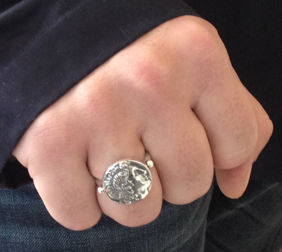
Alexander the Great coin ring
£80.00
Based on a silver tetradrachm minted during the reign of Lysimachos of Thrace, a successor (and boyhood friend) of Alexander the Great. The head is that of Alexander himself, depicted with the ram's horns of Zeus Ammon (the god whom Alexander had claimed as his father), indicating his posthumous deification. The original dates to the last quarter of the fourth century BC. Diameter of coin: 2cm
quantity
sad news about this collection
Due to the tragic, sudden death in early 2025 of Ioannis Vaphiadis, who made all this beautiful jewellery, the family's jewellery production has ceased.
This is all the remaining stock that I have. Ioannis was only in his late 50s, was such a lovely man and a dear friend.
I was so lucky to work closely with him for 19 years.If you already have a piece of his jewellery, cherish it.
more about this jewellery
It has been a privilege to work with the Vaphiadis family since 2007. They are one of the best manufacturers of sterling silver jewellery in Greece.
The collection is inspired by ancient Greek silver and gold coins, the art and jewellery of the Minoan civilisation, familiar symbolic motifs and images, and the animals that played a significant part in ancient Greek culture.
about Alexander the Great
Strategist, visionary, and conqueror, Alexander III of Macedon reshaped the ancient world not merely through conquest, but through a visionary blueprint for a globalized civilization. He died at 32, so his achievements are even ore phenomenol.
Succeeding his father, Philip II, in 336 BCE, his career quickly transcended the boundaries of traditional Greek statehood to forge a legacy of cultural synthesis and intellectual expansion.
One of his greatest achievements was to realise the concept of homonoia (harmony), an ambitious policy aimed at fusing Western and Eastern cultures. Rather than imposing a strict Greek hegemony over the fallen Achaemenid Empire, Alexander chose to integrate Persian nobility into his administrative apparatus, adopted local court dress, and respected indigenous religious practices, famously sacrificing to the Egyptian god Ammon.
Alexander was also a monumental agent of urbanisation and intellectual progress. He founded over 70 cities bearing his name, most notably Alexandria in Egypt. These hubs were not mere military outposts; they were sophisticated cultural hubs equipped with theatres, gymnasia, and marketplaces. By establishing these centres, he created an interconnected commercial network that stretched from the Mediterranean to the Indus River, facilitating an unprecedented exchange of goods, languages, and ideas.
Alexander also operated as an enthusiastic patron of science. He took with him on his campaigns geographers, botanists, and historians, mapping uncharted territories and collecting scientific data that enriched the broader global consciousness.
Though his life ended prematurely in 323 BCE, his enduring achievement was launching the Hellenistic Age. He successfully dismantled the insular city-state model, replacing it with a cosmopolitan world where Greek culture, language, and thought were interwoven with Eastern traditions, setting the foundations of centuries of global history.