
free DPD UK shipping over £50 | bespoke worldwide shipping

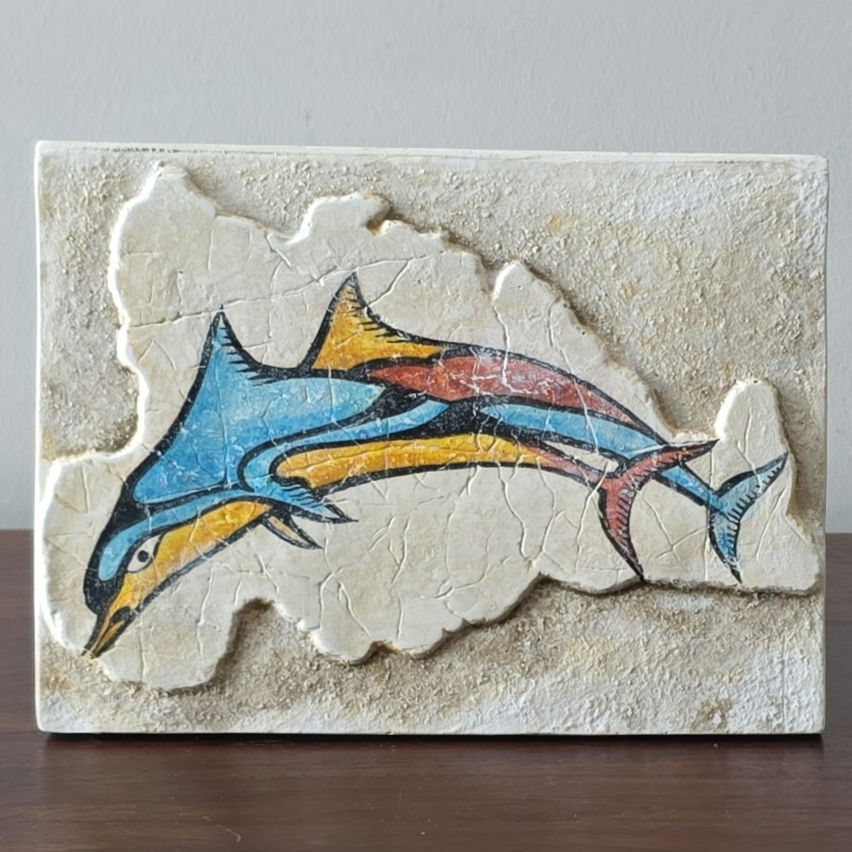


Minoan Flotilla Frieze fresco tile | twin dolphins
£40.00
A snapshot of colourful, leaping dolphins from this famous fresco of 2500 years ago now in the museum of ancient Thera on Santorini. Length: 16cm
Height: 12cm
Read more below about:
the original Flotilla Fresco
the Minoans
the symbolism of the dolphin
these fresco tiles
quantity
about the original Flotilla Fresco
The original Flotilla Frieze is a masterpiece spanning twelve meters along the walls of the West House in Akrotiri. Spyridon Marinatos and his team unearthed it during the 1971 and 1972 excavation seasons in Room 5 of the West House. The original restored fragments are permanently displayed at the Museum of Prehistoric Thera in Fira, Santorini
It's like a visual epic poem, depicting a grand naval procession travelling between two beautifully detailed coastal towns. The wealth of architectural, nautical, and landscape detail offers historians an unparalleled window into the Bronze Age thalassocracy—the powerful balance of sea-power of the ancient Aegean.
The incredible realism of the ships demonstrates the Minoans' advanced maritime engineering. Every vessel is drawn with precise attention to rigging, steering oars, and decorative stern ornaments. The ships are propelled by rows of twenty rowers, allowing historians to estimate their actual hulls at up to forty meters in length.
Unlike the war-filled art of ancient Egypt or Mesopotamia, Minoan maritime art emphasizes a fluid, joyful harmony between humanity and the natural world. Most archaeologists believe the flotilla depicts a sacred spring festival celebrating the seasonal opening of the Aegean sea lanes after winter. The ships are lavishly decorated with butterflies and flowers, indicating a joyous, religious voyage rather than a military invasion. The heavy wooden ships glide peacefully alongside leaping schools of wild dolphins, acting as spiritual guides, symbolizing divine protection and safe passage.
about the Minoans
Flourishing on Bronze Age Crete ca 3000–1100 BCE, the Minoans were a vibrant, colourful and innovative civilization that celebrated the beauty of life, nature's rhythms, and the sea which surrounded them.
Their extraordinary artistic output reflects their love of the natural world. Their sprawling palaces, most famously Knossos, Malia, and Phaistos, were adorned with breathtaking frescoes characterized by fluid lines and vivid colors. Instead of grim battle scenes, these murals depicted graceful leaping bulls, blue monkeys, and delicate saffron crocuses. Their creativity extended to their exquisite pottery, which featured dynamic motifs of octopus and coral wrapping around clay vessels, reflecting a sophisticated society deeply in tune with its environment.
This intimate connection with nature was inextricably linked to their mastery of the sea. Developing a formidable thalassocracy, the Minoans dominated the Aegean as unparalleled seafarers. Their advanced sailing vessels, elegantly depicted in frescoes at Akrotiri on Santorini/Thera, carried olive oil and fine ceramics across lucrative trade networks across the Mediterranean world, returning with exotic ivory and gold.
about the dolphin
Throughout antiquity, the dolphin was closely associated with Aphrodite (goddess of love and beauty), Apollo (god of culture and healing), Poseidon (god of the sea) and Dionysos (god of wine and drama).
Aphrodite, goddess of love, passion, and beauty, was born from the sea and is frequently depicted in ancient art either riding or accompanied by dolphins. This mythological romance transforms the dolphin into a gorgeous contemporary emblem of grace, emotional depth, affection, and the beauty of love.
In the famous Hymn to Apollo, Apollo, god of light, music, and prophecy et al transformed himself into a splendid dolphin so that he could guide a ship of sailors safely to the shore near Delphi, his sanctuary, the etymology of which is connected with the dolphin - delphis. Today, this makes the dolphin a powerful modern symbol of intuition and divine guidance.
The sea, domain of Poseidon, was an integral part of ancient Greek life. Sailors would regard the dolphin as an omen of good luck and divine protection against storms (the protectors of sailors). These days, they remain the ultimate symbol of safe passage, guidance, viewed as companions as we navigate life's rough waters. Greek art and coins frequently depict dolphins leaping playfully alongside ships, embodying the freedom of the ocean. Modern symbolism includes joy, playful energy, and a carefree spirit.
A famous Greek myth linking Dionysus to the dolphin describes how, when he was on a little jaunt in the Aegean, he was hijacked by pirates who mistook him for a wealthy prince. To punish their greed, Dionysus miraculously filled the ship with creeping ivy, turned the oars into serpents, and played phantom flutes until the terrified pirates jumped overboard. As they hit the water, he transformed them into dolphins. Rather than drowning, they were reborn with a renewed philanthropy, a love for mankind which made them guide and rescue sailors! This has contributed to the dolphin's being a modern symbol of second chances, radical transformation, and redemption.
Today, they also serve as a comforting symbol of transformation, deep emotional healing, and spiritual transition.
Dolphins were often depicted in the art of the seafaring Minoans, as gentle and intelligent mammals connecting the human world with the elemental world of nature.
about these fresco tiles
They are all made in Greece in the workshop of the Lioulias family, with whom It's All Greek is proud to have been working since 2004.
The tiles are made of a resin compound. Many have a 'craquelure' effect, to replicate the fine pattern of formed on the surface of paintings, in particular due to the ageing of paints and pigments. They are individually painted, by hand, which may result in subtle variations in colour and texture.
Should you wish to put these tiles in a bathroom or garden, it would be wise to apply a coat of transparent PVA sealant to protect them from rain and frost. They are supplied ready to hang, with a sturdy, embedded metal strip or, in the case of the larger ones, two strips which can be connected with picture wire. They can also be incorporated as features within a tiled wall.